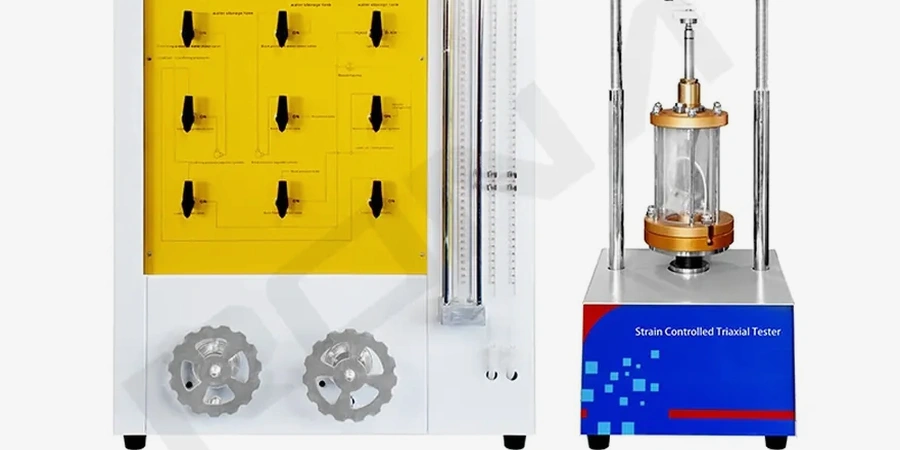
Austin sits on a complex geological boundary where the Balcones Escarpment splits the Edwards Plateau from the Blackland Prairie. Foundation design here deals with two very different soil profiles: shallow stiff clays over weathered limestone west of I-35, and deep expansive Taylor Marl east of it. Getting the shear strength parameters wrong on either side leads to expensive surprises. The triaxial test provides drained and undrained strength envelopes directly applicable to excavation support, slope cuts, and deep foundation capacity in these formations. We run the full suite — consolidated-undrained (CU), consolidated-drained (CD), and unconsolidated-undrained (UU) — matching the drainage conditions your project actually faces during construction and service life. For sites with soft terrace deposits near the Colorado River, the effective stress parameters from CU testing become critical input into the slope-stability analysis that Austin's drainage criteria manual requires for any cut over 4 feet.
Effective friction angles in Austin's weathered marl range from 22 to 28 degrees depending on preconsolidation stress — use site-specific triaxial data, not textbook tables.
Methodology and scope
Local considerations
A 10-story mixed-use project on East Riverside Drive ran into trouble when the geotechnical report relied on SPT blow counts alone to estimate shear strength for a 25-foot excavation. The contractor encountered a 6-foot layer of saturated silty clay with undrained shear strength below 500 psf — less than half what the correlations predicted. Shoring had to be redesigned mid-project, adding six weeks and significant cost. That layer showed up clearly in CU triaxial tests we ran afterward: effective friction angle of 18 degrees with a cohesion intercept near zero at high strains. The problem wasn't the soil — it was the testing gap. Austin's terrace deposits along the Colorado River corridor contain interbedded soft clays and loose silts that SPT-based correlations misrepresent. Triaxial testing on undisturbed Shelby tube samples eliminates that blind spot. For any Austin excavation deeper than 15 feet near the river, we recommend at least three CU triaxial tests per soil unit to bracket the strength envelope before finalizing shoring design.
Regulatory framework
ASTM D4767-11 governs consolidated-undrained and consolidated-drained triaxial compression testing, ASTM D2850-15 addresses unconsolidated-undrained triaxial testing, and ASTM D422
Other technical services
Consolidation Testing
One-dimensional consolidation per ASTM D2435 on undisturbed samples. Settlement magnitude and rate predictions for Austin's compressible terrace soils and Taylor Marl.
Unconfined Compression
Quick undrained strength screening on cohesive soils per ASTM D2166. Useful for preliminary subgrade assessment where full triaxial isn't yet warranted.
Atterberg Limits and Soil Classification
Liquid limit, plastic limit, and plasticity index per ASTM D4318, combined with grain-size per ASTM D6913. Critical for correlating triaxial results across similar soil units.
Typical parameters
Frequently asked questions
What's the difference between CU and CD triaxial tests, and which one does my Austin project need?
CU (consolidated-undrained) tests measure pore pressure during shear and give both total-stress and effective-stress parameters. CD (consolidated-drained) tests shear slowly enough to dissipate all excess pore pressure, yielding drained parameters only. For Austin excavations in low-permeability clays, CU with pore pressure measurement is the standard — it provides the undrained strength for short-term stability and the effective friction angle for long-term drained analysis. CD tests are appropriate for free-draining soils like the granular fills over limestone, where construction loads apply slowly relative to drainage rates.
How much does a triaxial test program cost for a typical Austin building site?
How long does triaxial testing take from sample delivery to final report?
Standard turnaround is 10 to 14 business days for a set of three specimens. The limiting factor is the consolidation and shear phases — a single CU test on Austin's stiff clays takes 4 to 7 days depending on permeability. We can expedite to 7 business days for an additional fee, but we never compromise the saturation phase; incomplete saturation produces unreliable effective stress parameters.