Austin sits about 80 miles east of the Balcones Fault Zone, a region that generates small to moderate earthquakes more often than people realize. The last notable event in the area was a magnitude 4.0 near Falls County in 2021, and while the city itself is not directly on the fault, the fractured limestone and expansive clay soils here amplify ground motion in ways that standard construction does not fully address. For critical facilities, healthcare buildings, or high-end residential projects, a conventional fixed-base design leaves the structure vulnerable to resonance effects. Base isolation seismic design decouples the building from ground movement, and in Austin's specific soil conditions, that decoupling requires a much more detailed site-specific analysis than a generic catalog solution. Our team performs the full geotechnical characterization and dynamic analysis needed to design an isolation system that actually matches the subsurface profile, not just the code minimum.
A well-designed base isolation system in Austin shifts the structure's fundamental period beyond 2.5 seconds, cutting seismic forces by a factor of four compared to a fixed-base building.
Methodology and scope
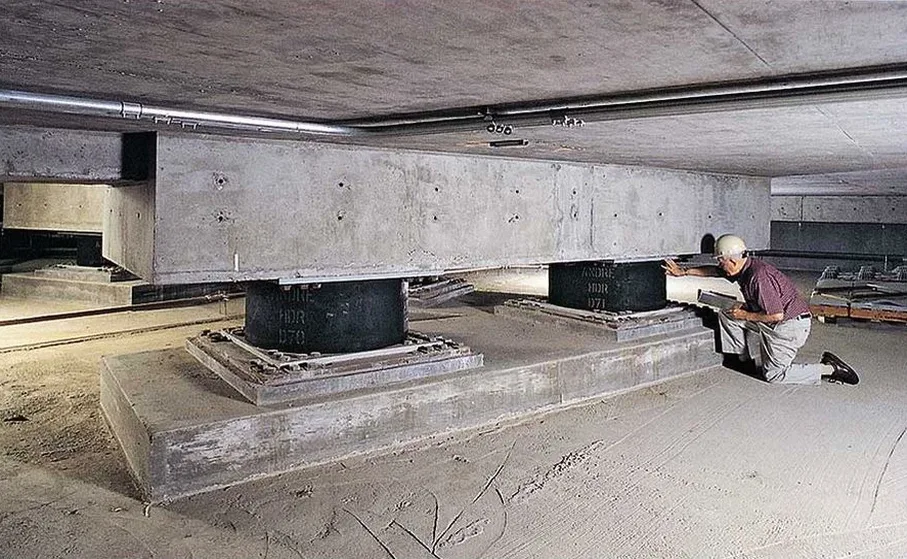
Local considerations
A mid-rise office building on the east side of Austin, near the Colorado River floodplain, was designed with a fixed-base concrete frame. During construction, additional borings revealed 25 feet of soft, high-plasticity clay with undrained shear strength below 800 psf, conditions that had been missed in the preliminary investigation. The original structural design assumed Site Class C, but the actual conditions classified as Site Class E, tripling the design spectral accelerations at short periods. Retrofitting with a base isolation system meant cutting the existing ground-floor slab, installing a moat wall, and placing friction pendulum isolators on the existing pile caps, a six-month delay and a budget increase of roughly 15 percent. The engineering lesson is that skipping a detailed site-specific seismic hazard analysis before schematic design in Austin is a gamble with the construction schedule. The Balcones fault system may not produce large events, but the soil amplification here turns moderate shaking into significant structural demands.
Regulatory framework
ASCE 7-22 Minimum Design Loads and Associated Criteria for Buildings and Other Structures, IBC 2021 Chapter 17 Structural Tests and Special Inspections, ASTM D7400 Standard Test Methods for Downhole Seismic Testing, and ISO 22762 Elastomeric Seismic-Protection Isolators.
Other technical services
Performance-Based Isolation Design and Peer Review
We develop project-specific design criteria aligned with ASCE 7-22 performance objectives: operational for MCE, immediate occupancy for DBE. The design package includes nonlinear time-history analysis with a suite of at least eleven ground motion pairs, selected and scaled to match the site-specific uniform hazard spectrum. We also provide independent peer review documentation for permitting.
Isolator Prototype and Production Testing Oversight
Per IBC Chapter 17 and ASCE 7-22 Section 17.8, every isolator unit must undergo rigorous testing. We supervise the prototype tests (full-scale, including aging, scragging, and temperature effects) and the production tests at the manufacturer's facility, verifying that the force-displacement loops match the design properties within the specified tolerances.
Typical parameters
Frequently asked questions
What is the typical cost range for base isolation design on an Austin project?
Does base isolation make sense for Austin given the low seismicity?
It depends on the facility's function and the soil conditions. For essential facilities like hospitals and emergency response centers, the IBC requires a higher seismic performance category. On the soft clays of East Austin, the site amplification can push design forces well above what a fixed-base design can handle economically, making isolation a competitive option even in moderate seismicity.
How do you determine the ground motion for the isolation design?
We perform a site-specific probabilistic seismic hazard analysis using the USGS 2018 NSHM, adjusted for local soil amplification via a site response analysis. The output is a uniform hazard spectrum and a set of spectrally matched ground motion records that represent the seismotectonic environment of the Balcones Fault Zone.
What type of testing is required for the isolators before installation?
ASCE 7-22 requires prototype testing of two full-scale isolators per type, including cycles at design displacement, maximum displacement, and service-level loading. Additionally, every production isolator must be tested to verify the effective stiffness and damping ratio, with acceptance criteria typically set at plus or minus 10 percent of the design value.