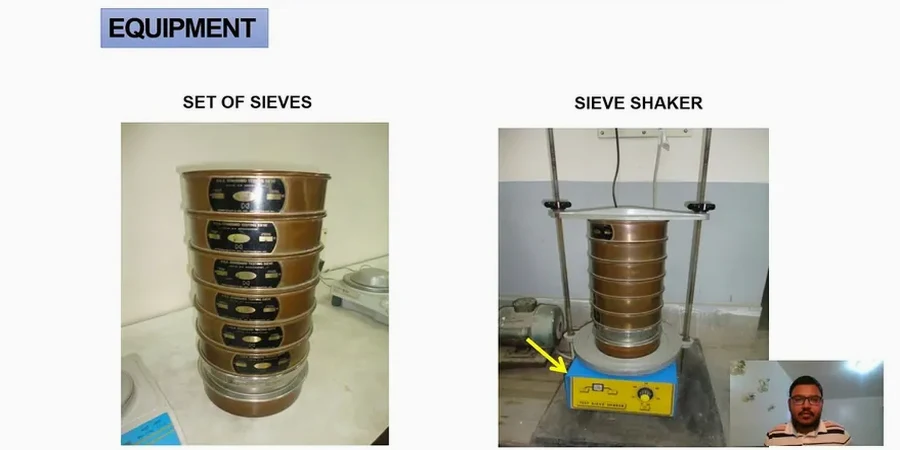
A set of 8-inch brass sieves and a 152H hydrometer sitting on the lab bench tells you more about Austin subgrade than a dozen borehole logs alone. The sieves catch everything from fine gravel down to silt-sized particles, while the hydrometer measures the clay fraction that settles over a 24-hour period. Our Austin lab runs the full stack—ASTM D6913 for the coarse fraction and ASTM D7928 for the fines—because the city's geology switches from Edwards Limestone residuum to Blackland Prairie clay within half a mile. When we receive samples from a site off MoPac or out toward Del Valle, the grain size curve is often the first number the geotechnical engineer wants to see before assigning a USCS group symbol. Getting that curve right determines whether the material can be compacted as structural fill or needs to be undercut. The Atterberg limits test runs in parallel on the same sample, so the plasticity data lines up directly with the particle size distribution for classification.
A grain size curve is the single most cost-effective data point for predicting how Austin soil will behave under load and moisture change.
Methodology and scope
Local considerations
The contact between the Edwards Plateau and the Blackland Prairie runs roughly along the Balcones Fault Zone, and within a few hundred feet the soil can flip from low-plasticity silt to fat clay with a swell potential exceeding 4 percent. A grain size analysis that stops at the #200 sieve—without the hydrometer—misses the clay fraction entirely and produces a misleading classification. In our experience, that is the single most common cause of foundation distress we see in East Austin and the Riverside corridor: a geotech report from a prior investigation labeled the material as ML silt when it was actually CH clay because nobody ran the sedimentation test. The hydrometer curve also feeds directly into liquefaction screening for sites near the Colorado River, where loose silty sand layers at 15 to 25 feet depth can plot in the contractive zone on a grain size chart. When the particle size distribution shows a gap-graded or uniformly graded sand, the liquefaction assessment parameters shift significantly, and the SPT blow counts alone will not catch the problem.
Explanatory video
Regulatory framework
ASTM D6913-17 delineates standard test methods for determining the particle-size distribution of soils via sieve analysis, while ASTM D7928-21 specifies the standard test method for particle-size distribution of fine-grained soils through hydrometer analysis. ASTM D2487-17 provides the standard practice for classifying soils for engineering purposes under the Unified Soil Classification System, and ASTM D422-63(2007)e2, although withdrawn, remains referenced for particle-size analysis of soils. Additionally, TxDOT Tex-110-E addresses particle size analysis of soils.
Other technical services
Combined Sieve and Hydrometer Package
The full ASTM D6913/D7928 suite from coarse gravel down to 0.001 mm clay. We wash the #200 fraction, oven-dry the retained material, and run the hydrometer on the fines in a temperature-controlled sedimentation cylinder. The report includes D10, D30, D60, coefficients of uniformity and curvature, and the USCS group symbol with group name per ASTM D2487.
Wash Sieve Only (Coarse Fraction)
For granular base course, concrete aggregate, and filter sand specifications where the fines content is the pass-fail criterion. We run the full coarse stack from 3 inches to #200 with a pre-wash, and report percent passing each sieve, fineness modulus if requested, and compliance with TxDOT or City of Austin aggregate gradation bands.
Typical parameters
Frequently asked questions
How much does a grain size analysis with hydrometer cost in Austin?
Do I really need the hydrometer test or is a wash sieve enough?
If more than 12 percent of your sample passes the #200 sieve, you need the hydrometer. The wash sieve only tells you the total fines content—it cannot distinguish between silt and clay. In Austin's Blackland Prairie clays, the difference between a ML silt and a CH clay is exactly what the hydrometer reveals, and that distinction controls foundation type, swell potential, and excavation stability.
What sample size do you need for a full grain size analysis?
For fine-grained soils we need a minimum of 500 grams of material. For sandy or gravelly soils with particles up to 3 inches, we require at least 5 kilograms. If you are submitting a split spoon sample from an SPT boring, the entire 18-inch liner contents typically provide enough material for the combined procedure, though we prefer a separate bag sample taken from the same depth interval for the hydrometer portion.
How long does the grain size test take from sample drop-off to report?
Standard turnaround is three to four business days because the hydrometer sedimentation phase alone requires 24 hours of readings at specified intervals. The sieve portion can be completed within one day. If you need results faster for a concrete pour or earthwork decision, we can expedite to two days by running the sedimentation cylinder overnight and prioritizing the data reduction the following morning.