The most expensive mistake we see on Austin pavement projects is assuming a CBR value from a textbook. Central Texas soils don't read textbooks. The Blackland Prairie clays that dominate the eastern half of the metro area can swell to three times their dry volume and lose bearing capacity after a single rain event. The Texas Department of Transportation won't accept assumed numbers for public roadway design. A soaked laboratory CBR test measures exactly how much strength your subgrade retains under worst-case moisture conditions. We run these daily at our Austin lab, and the gap between what engineers expect and what the extruded sample actually delivers runs anywhere from 40 to 200 percent. Before you pour 12 inches of flexible base on a parking lot off Parmer Lane, you need a number that holds up under a field inspector's scrutiny. Combining CBR data with grain size analysis clarifies whether the fine fraction is driving the strength loss or if aggregate interlock will survive saturation.
A soaked CBR value is the only subgrade strength number TxDOT district engineers will accept for flexible pavement design.
Methodology and scope
Local considerations
Austin's sprawl since the 1980s pushed development deep into the Balcones Escarpment transition zone, where cut-and-fill operations mixed residual limestone gravel with expansive clay seams. A pavement section designed on a CBR of 8 that encounters a lens of weathered shale with a soaked CBR of 2 will rut within two seasons. The I-35 corridor expansion exposed exactly this problem in several segments where subgrade variability was underestimated. The lab CBR test quantifies that risk before the asphalt plant fires up. Another failure mode we diagnose regularly involves contractors who compact on the dry side of optimum to hit density faster. That practice leaves the soil structure hungry for water, and the 96-hour soak in the CBR mold reveals the strength collapse that field density tests miss. For projects where the subgrade CBR falls below 3, the owner faces a choice: over-excavate and replace, chemically stabilize with lime, or accept a thicker structural section. Each option has a different cost trajectory, and the CBR number is the gate that opens whichever path you end up taking.
Regulatory framework
AASHTO T-193, ASTM D1883, TxDOT Tex-117-E
Other technical services
Soaked CBR with Swell Measurement
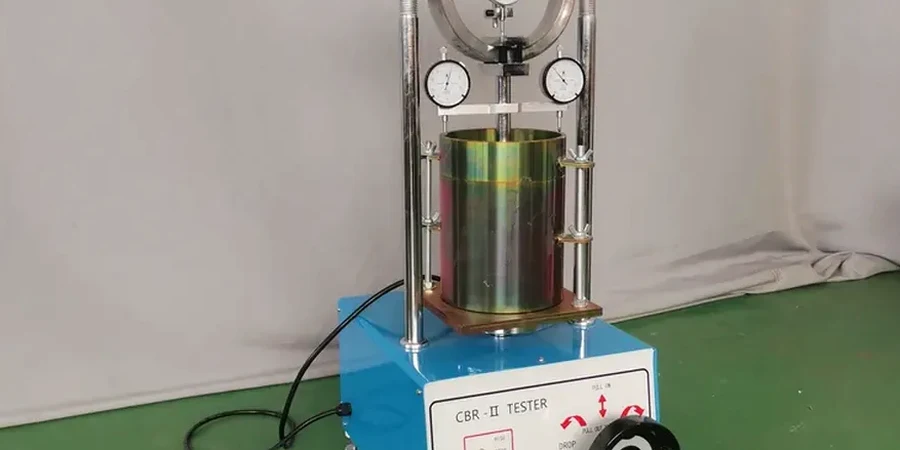
Full AASHTO T-193 procedure including 96-hour soak, swell monitoring every 24 hours, and corrected CBR at 0.100 and 0.200 inches of penetration. We report moisture-density relationship from companion Proctor specimens compacted in the same lab session.
CBR on Remolded Field Samples
Bulk samples collected from test pits or SPT split spoons are remolded to target density and moisture in our Austin lab. This service supports forensic investigation of pavement failures where the in-place condition must be replicated before testing.
Typical parameters
Frequently asked questions
What does a laboratory CBR test cost in Austin?
How long does the CBR test take from sample delivery to report?
The minimum turnaround is five working days. Compaction takes one day, the soaking period runs four days, and the penetration test plus calculations and reporting fills the fifth day. Expedited schedules are possible if the project team accepts a 48-hour soak with a note in the report, but TxDOT submittals require the full 96 hours.
What CBR value does TxDOT require for Austin subgrades?
TxDOT standard specifications generally require a minimum soaked CBR of 5 for subgrade soils under flexible pavement. If the lab CBR comes back lower, the standard remedy is either 6 inches of lime stabilization or an increase in flexible base thickness per the district's pavement design chart. Our report includes the direct comparison to the specification threshold so the design engineer can document the decision immediately.