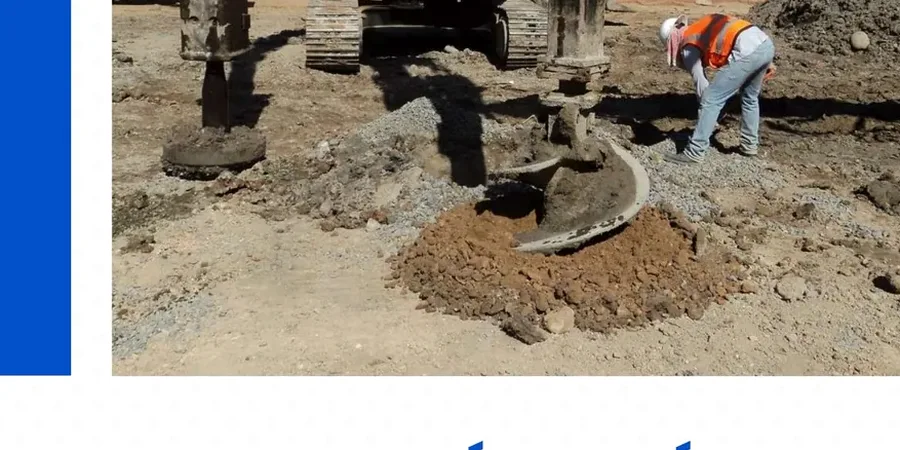
East Austin near the Colorado River floodplain versus the limestone benches west of MoPac—two sites, two completely different soil profiles. A project off Springdale Road often hits soft alluvial clays with SPT blow counts under 5 in the top 15 feet. That same footprint in Westlake might sit on stiff Eagle Ford shale weathered to a fat clay. Both conditions can cause excessive settlement, but the fix is not always deep foundations. Stone column design gives contractors a way to stiffen the ground mass itself, boosting bearing capacity without waiting months for surcharge consolidation. We work with test pits to log the problematic strata first, then calibrate the column grid to the actual undrained shear strength measured in the lab. The result? A treated pad ready for conventional footings or a slab-on-grade, often at half the schedule of driven piles.
A well-designed stone column grid transforms soft Austin clays into a composite mass that can support 4,000 to 6,000 psf—no deep foundations required.
Methodology and scope
Local considerations
Austin's building boom since 2010 has pushed new construction onto land that old-timers knew to avoid: the deep, fat clay pockets east of I-35 and the floodplain silts along Onion Creek. A structural engineer specifying a mat foundation on these soils without ground improvement is betting against a thousand years of alluvial deposition. The risk shows up silently—differential settlement that cracks slab-on-grade floors within the first three years of occupancy. In one tilt-wall warehouse we reviewed near McKinney Falls, the geotech report warned of 3 inches of total settlement under a 60-foot column bay. The owner balked at the cost of stone column design initially. The liquefaction potential in these loose silts adds another layer of liability that a dense column grid directly mitigates by densifying the surrounding soil mass.
Explanatory video
Regulatory framework
The design references include ASTM D1586-18 (SPT for site characterization), FHWA-NHI-16-072 (Ground Improvement Methods), ASCE/SEI 7-22 Chapter 20 (Site Classification), and IBC 2021 Section 1806 (Presumptive Load-Bearing Values, modified by ground improvement).
Other technical services
Vibro-Replacement Feasibility Study
Desktop review of existing geotechnical data to confirm stone columns are the right fix. We evaluate CPT tip resistance or SPT N-values against the Baez and Martin (1993) design curves and give a go/no-go recommendation within five business days.
Column Grid Design Package
Full set of stamped drawings showing column diameter, spacing, depth, backfill gradation, and installation sequence. Includes settlement analysis using the Priebe method and bearing capacity verification per the FHWA ground improvement manual.
Specification Writing for Austin Contractors
We write tight performance specs that local deep foundation subs can bid on apples-to-apples. Specs cover aggregate quality per ASTM D448, top-feed versus bottom-feed method, and acceptance criteria based on modulus load tests.
Post-Installation QA/QC
Field verification using plate load tests on individual columns and between columns. We compare measured modulus and settlement against design predictions and issue a final letter of conformance for the building permit file.
Typical parameters
Frequently asked questions
What does stone column design cost for a typical Austin commercial building pad?
How do you verify that the stone columns actually work in Austin's fat clays?
We don't guess. Post-installation, we run modulus load tests using a reaction frame or a loaded truck. The test applies 200 percent of the design bearing pressure to a single column and to the soil between columns. We measure deflection with dial gauges and back-calculate the composite modulus. If the measured settlement ratio is below 2.5 compared to untreated ground, the design is validated.
Can stone columns replace drilled piers for a tilt-wall warehouse in East Austin?
In many cases, yes. If the site has soft clays less than 30 feet deep and the water table is manageable, a stone column grid can support a 6-inch slab-on-grade and the perimeter wall footing without deep piers. We've done this for several tilt-up buildings near the Tesla gigafactory and along SH-130. The key is verifying that the improved ground meets the 4,000 psf bearing requirement with total settlement under one inch.
How long does the design process take from site investigation to stamped drawings?
Once we have the geotechnical report with SPT data and lab tests (Atterberg limits, consolidation curves), the design takes seven to ten working days. If we need to run additional borings or CPT soundings ourselves, add two weeks for field work and lab turnaround. We always coordinate with the civil engineer and the contractor's schedule to avoid holding up the grading permit.
What backfill material do you specify for stone columns in the Austin metro?
We specify a clean, angular crushed limestone—typically ASTM No. 57 or TxDOT Grade 3—with less than five percent passing the No. 200 sieve. The limestone needs to be hard enough to resist crushing during vibro-compaction, so we avoid softer dolomites. Quarries in Georgetown and Round Rock consistently produce stone that meets our friction angle requirement of 40 degrees or better.